In the rapidly evolving landscape of digital marketing, Artificial Intelligence (AI) has transitioned from a futuristic buzzword to an essential component of modern strategy. As of 2026, businesses that fail to integrate AI risk falling behind in efficiency, personalization, and customer insight. The challenge for many marketers is no longer *if* they should adopt AI, but *how* to do so effectively. This guide provides a comprehensive, step-by-step framework for understanding, planning, and implementing AI in your digital marketing efforts to drive measurable growth.
This in-depth tutorial will walk you through the core technologies, strategic applications, and practical implementation steps. You’ll learn how to leverage AI to not only automate tasks but to unlock predictive insights, deliver hyper-personalized experiences, and ultimately, achieve a significant competitive advantage. Whether you’re a small business owner or part of a large enterprise marketing team, this guide will equip you with the knowledge to harness the power of AI.
Table of Contents
- What is AI in Digital Marketing, Really?
- Why AI is No Longer Optional for Marketers in 2026
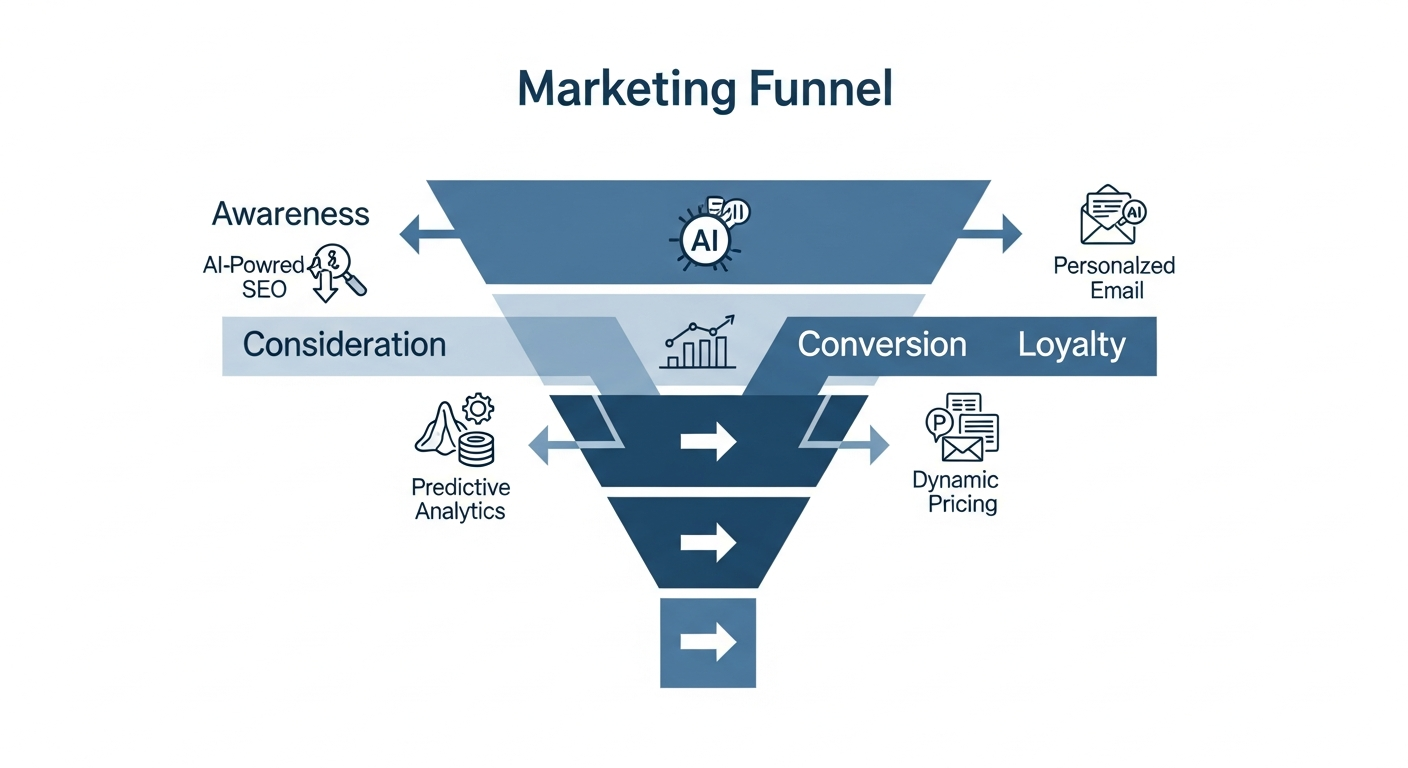
- Core Applications of AI Across the Marketing Funnel
- How to Build Your AI-Powered Digital Marketing Strategy: A 5-Step Framework
- Choosing the Right AI Marketing Tools: A Practical Guide
- Navigating the Challenges and Ethical Considerations
- The Future of Marketing: What’s Next for AI?
- Frequently Asked Questions
What is AI in Digital Marketing, Really?
AI in digital marketing refers to the use of intelligent technologies to automate and enhance marketing strategies by processing and analyzing vast amounts of data to make real-time decisions. It goes beyond simple automation by learning from data patterns to predict consumer behavior, personalize customer journeys, and optimize campaign performance without constant human intervention.
Defining the Core Technologies: ML, NLP, and Generative AI
To truly grasp AI’s potential, it’s crucial to understand the key technologies that power it:
- Machine Learning (ML): This is the engine of most marketing AI. ML algorithms are trained on historical data to identify patterns and make predictions. In marketing, this is used for lead scoring, customer segmentation, and forecasting sales trends.
- Natural Language Processing (NLP): NLP gives machines the ability to understand, interpret, and generate human language. This technology is the foundation for chatbots, social media sentiment analysis, and AI-powered SEO tools that analyze search intent.
- Generative AI: A more recent and powerful advancement, Generative AI can create new, original content. This includes writing blog posts, designing images, producing video scripts, and personalizing email copy on a massive scale. These tools often leverage advanced models like GPT-4 or diffusion models to generate text and images, respectively.
Beyond Automation: How AI Differs from Traditional Marketing Tools
A common misconception is that AI is just a more advanced form of marketing automation. While both aim to improve efficiency, their core functions are fundamentally different. Traditional automation follows predefined, rule-based workflows (e.g., “If a user downloads an ebook, send them this email sequence”). In contrast, AI is dynamic and predictive. An AI system can analyze a user’s complete browsing history, predict their likelihood to purchase, and then decide the best channel, message, and time to engage them—a level of decision-making that rules-based systems cannot achieve.
Why AI is No Longer Optional for Marketers in 2026
The strategic imperative to adopt AI in marketing is driven by fundamental shifts in consumer expectations and the digital environment itself. According to a 2025 Gartner report, marketing leaders who have fully integrated AI report a 25% increase in qualified leads, creating a wider gap between them and the competition.
Achieving Hyper-Personalization at an Unprecedented Scale
Today’s consumers expect experiences tailored to their individual needs and preferences. AI makes this possible by analyzing data points from thousands of touchpoints—website visits, purchase history, social media interactions, and more. This allows brands to deliver personalized product recommendations, dynamic website content, and uniquely relevant ad copy to every single user, fostering deeper engagement and loyalty.
Gaining a Competitive Edge with Predictive Insights and Forecasting
Instead of reacting to past performance, AI enables marketers to act proactively. Predictive analytics can forecast which customers are at risk of churning, identify which leads are most likely to convert, and even predict future market trends. For example, an e-commerce store can use AI to analyze purchase frequency and website engagement, flagging customers who haven’t purchased in 90 days but previously bought monthly. The system can then automatically trigger a personalized re-engagement campaign. This foresight allows for more efficient allocation of marketing budgets and resources, focusing efforts where they will yield the highest return.
Adapting to AI-Powered Search and Conversational Interfaces
Search engines like Google are increasingly using AI to understand and answer user queries directly, often through AI Overviews. This changes the SEO landscape dramatically, demanding a shift in content strategy. Success now depends on creating content that directly answers conversational questions and satisfies complex user intent. To do this effectively, marketers must optimize for these new AI-driven search ecosystems.
How to Optimize for AI Overviews:
- Create Concise Answer Blocks: Structure content with clear headings and short, direct paragraphs that answer a specific question, making them easily extractable.
- Use Schema Markup: Implement FAQPage, HowTo, and Article schema to help AI systems understand the content’s structure and purpose.
- Focus on Factual Accuracy and Citations: Prioritize well-researched, citable content. According to modern SEO practice, AI systems favor authoritative sources with verifiable facts.
- Emphasize E-E-A-T: Build author bios and an ‘About Us’ page that clearly demonstrates your Experience, Expertise, Authoritativeness, and Trust in the subject matter.
Core Applications of AI Across the Marketing Funnel
AI’s impact is felt at every stage of the customer journey. By integrating intelligent tools, marketers can optimize workflows, improve decision-making, and deliver a more cohesive experience from first contact to final purchase and beyond.
AI for SEO and Content Strategy
AI has become indispensable for modern SEO. Tools now use NLP to perform deep topic cluster analysis, identify semantic keyword opportunities, and analyze competitor strategies at a granular level. AI can predict the ranking potential of a piece of content before it’s even written and provide recommendations to optimize it for both search engines and user intent.
AI-Powered Content Creation and Repurposing
Generative AI tools have revolutionized content creation. Instead of just generating new content, they excel at maximizing its value. For example, a marketer could use a tool like OmniscribeAI to automatically convert a 30-minute webinar into a series of SEO-friendly blog posts and social media threads. For generating new content from scratch, a platform like AIBG IntelliAgent can produce a high-quality first draft based on target keywords and competitor analysis. This dramatically reduces production time and ensures a consistent presence across multiple channels.
Revolutionizing PPC and Media Buying
In paid advertising, AI automates and optimizes bidding strategies in real time. Platforms like Google Ads use machine learning to adjust bids based on hundreds of signals, predicting the likelihood of a click leading to a conversion. AI can also analyze ad creatives and predict performance, helping marketers design more effective campaigns from the start.
Intelligent Email Marketing and Lifecycle Automation
AI takes email marketing beyond simple segmentation. It can determine the optimal send time for each individual subscriber, personalize subject lines and content based on browsing behavior, and automatically generate email copy that resonates with specific audience segments. This leads to higher open rates, click-through rates, and conversions.
Enhancing Social Media Management and Analytics
AI tools can analyze social media trends and conversations to provide insights into what content will perform best. They can also perform sentiment analysis to gauge brand perception and identify potential customer service issues before they escalate. Furthermore, AI can optimize posting schedules for maximum engagement across different platforms.
AI-Driven Customer Analytics and Reporting
One of AI’s greatest strengths is its ability to process and find patterns in massive datasets. AI analytics platforms can consolidate data from your CRM, website, and ad platforms to build a unified view of the customer. They can uncover hidden correlations, identify the most valuable customer segments, and provide clear, actionable reports that would take a human analyst weeks to compile.
How to Build Your AI-Powered Digital Marketing Strategy: A 5-Step Framework
Adopting AI successfully requires a structured approach. Simply buying a tool without a clear plan will lead to wasted resources and disappointing results. Follow this five-step framework to integrate AI into your marketing operations strategically.
Step 1: Define Clear Business Objectives and KPIs
Start with your goals, not the technology. What do you want to achieve? Examples include:
- Increase lead conversion rate by 15%.
- Reduce customer churn by 10%.
- Improve marketing campaign ROI by 20%.
- Decrease content production time by 40%.
Your objectives will determine which AI applications will provide the most value.
Step 2: Audit Your Data Infrastructure and Marketing Stack
AI is fueled by data. Assess the quality, accessibility, and integration of your data sources. A strong data foundation often involves a Customer Data Platform (CDP), which unifies customer data from all sources into a single, coherent view, providing the clean fuel AI models need. Without clean, reliable data, any AI initiative is destined to fail.
Step 3: Identify High-Impact AI Use Cases for Your Business
Based on your objectives and data audit, identify the most promising use cases. A common mistake businesses make is trying to implement too many AI initiatives at once. Prioritize based on potential impact and feasibility. For example, if your primary goal is to improve ROI, an AI-powered ad bidding tool might be the best place to start. If efficiency is the goal, an AI content generator could be the top priority.
Step 4: Select the Right AI Marketing Tools (Build vs. Buy)
For the vast majority of businesses, buying an existing AI solution is far more practical than building one from scratch. When evaluating tools, consider factors like ease of use, integration with your existing marketing stack, customer support, and scalability. Start with free trials to test the technology with your own data and workflows.
Step 5: Implement, Test, and Iterate on Your AI Initiatives
Begin with a pilot project. Implement your chosen AI tool on a small scale, measure its performance against your predefined KPIs, and gather feedback from your team. Use these learnings to refine your approach before rolling it out more broadly. AI is not a “set it and forget it” solution; it requires continuous monitoring and optimization.
A key strategy we advise clients on is to not try to boil the ocean. Begin your AI journey with a pilot project focused on a single, reliable data source, such as your CRM or GA4 event data. Proving ROI on a contained, high-impact use case like lead scoring builds the business case and internal momentum for broader AI adoption.
Common Pitfalls and How to Avoid Them
Real-world implementations often encounter predictable hurdles. Being aware of these common mistakes can save significant time and resources.
- Mistake 1: Poor Data Hygiene. Starting with messy, incomplete, or siloed data is the number one cause of AI project failure. It leads to flawed insights and unreliable predictions. To avoid this, conduct a thorough data audit and cleaning process *before* you even select a tool.
- Mistake 2: Chasing ‘Shiny Objects’. It’s easy to get excited about the latest AI technology. However, successful implementation comes from choosing a tool that solves a specific, defined business problem, not from adopting technology for its own sake. Always tie your tool selection back to your KPIs from Step 1.
- Mistake 3: Neglecting the ‘Human-in-the-Loop’. Over-relying on AI for creative or strategic tasks without human oversight can lead to off-brand, inaccurate, or generic content. Use AI as a powerful co-pilot, not an autopilot. Human expertise is essential for final review, strategic direction, and ensuring quality.
Choosing the Right AI Marketing Tools: A Practical Guide
The market for AI marketing tools is crowded and can be overwhelming. To make an informed decision, it’s helpful to categorize them and evaluate them against a standard set of criteria.
All-in-One Platforms vs. Specialized Point Solutions
You’ll encounter two main types of tools:
- All-in-One Platforms: These offer a wide range of AI features across different marketing functions (e.g., SEO, email, analytics) in a single suite. They are powerful but can be complex and expensive.
- Specialized Point Solutions: These tools focus on doing one thing exceptionally well, such as AI copywriting, social media scheduling, or SEO analysis. They are often easier to adopt and more affordable.
Many businesses find success by starting with a few specialized solutions to address immediate needs and then exploring a more integrated platform as their AI maturity grows. You can find a suite of powerful AI-driven products designed to empower your digital journey and streamline operations.
Key Features to Evaluate in an AI Tool
When comparing options, look for:
- Integration Capabilities: How well does it connect with your CRM, CMS, and other essential tools?
- Data Handling & Privacy: How does the tool process and secure your data?
- User Interface (UI) & Ease of Use: Is the platform intuitive for non-technical users?
- Customization & Control: Can you fine-tune the AI’s models and outputs to fit your brand?
- Support & Training: What resources are available to help your team succeed?
Navigating the Challenges and Ethical Considerations
While AI offers immense potential, its implementation comes with challenges and responsibilities that marketers must address proactively.
Overcoming Data Privacy and Security Hurdles
Using customer data to power AI personalization requires strict adherence to privacy regulations like GDPR. Marketers must be transparent about how data is collected and used, and ensure their AI vendors have robust security protocols in place to protect sensitive information.
The ‘Human-in-the-Loop’ Model: Why Human Oversight is Critical
AI is a powerful assistant, not a replacement for human judgment and creativity. The most successful AI strategies employ a “human-in-the-loop” model, where marketers review, refine, and approve AI-generated outputs. This ensures brand consistency, factual accuracy, and strategic alignment—qualities that AI alone cannot guarantee.
Addressing Algorithmic Bias and Ensuring Fairness
AI models learn from the data they are trained on. If that data contains historical biases, the AI can perpetuate or even amplify them, leading to unfair or exclusionary marketing practices. It is the marketer’s ethical responsibility to be aware of this risk, audit their data for bias, and ensure their AI-driven campaigns are inclusive and equitable.
The Future of Marketing: What’s Next for AI?
As we look beyond 2026, the integration of AI into marketing will only deepen, leading to even more sophisticated and autonomous systems.
The Rise of Autonomous AI Marketing Agents
We are moving towards a future where AI agents can manage entire campaigns autonomously. These agents will be given a budget and a goal, and they will then conduct market research, develop creative, execute media buys, and optimize performance across all channels with minimal human input.
AI’s Role in Shaping Immersive AR/VR Experiences
As augmented and virtual reality become more mainstream, AI will be the engine that powers personalized experiences within these immersive worlds. It will generate dynamic environments, create interactive NPC (non-player character) brand ambassadors, and tailor virtual product discovery for each user.
The Shift Towards Proactive, AI-Orchestrated Customer Journeys
The ultimate evolution is a shift from reactive personalization to proactive orchestration. In the near future, AI won’t just respond to a customer’s actions; it will anticipate their future needs and proactively guide them on a journey, delivering the right information and solutions before the customer even realizes they need them.
Traditional vs. AI-Powered Marketing: A Comparison
| Marketing Function | Traditional Approach | AI-Powered Approach |
|---|---|---|
| Customer Segmentation | Manual segmentation based on broad demographics (age, location). | Automated, predictive micro-segmentation in real-time based on behavior. |
| Content Creation | Entirely human-driven, time-consuming research and writing. | AI-assisted first drafts, idea generation, and content repurposing at scale. |
| Ad Campaign Bidding | Manual bid adjustments based on past performance reports. | Real-time, automated bidding based on predictive conversion likelihood. |
| A/B Testing | Testing limited variations (e.g., two different headlines) over a long period. | Multivariate testing of thousands of variations simultaneously to find the optimal combination. |
Frequently Asked Questions
Here are answers to some common questions about using AI in digital marketing. For more product-specific information, you can also view our main Frequently Asked Questions page.
What are the main benefits of using AI in digital marketing?
The primary benefits include significantly improved efficiency through automation, deeper customer insights from data analysis, enhanced ROI from optimized ad spend and targeting, and the ability to deliver highly personalized customer experiences at scale.
Can small businesses afford to use AI in their marketing?
Yes. While enterprise solutions can be expensive, the market in 2026 offers many scalable and affordable AI tools, particularly for specialized tasks like content creation, social media scheduling, and SEO analysis. Many platforms offer flexible, transparent pricing on a usage basis, making them accessible to businesses of all sizes.
How do I start learning about AI for marketing?
Start by identifying a specific pain point in your current marketing workflow. Research AI tools designed to solve that problem (e.g., an AI copywriter for blog posts). Begin with a free trial to understand its capabilities and limitations. Following industry blogs and taking introductory online courses can also build a strong foundational knowledge.
Will AI replace digital marketers?
AI is unlikely to replace digital marketers. Instead, it will augment their capabilities and transform their roles. Marketers will shift from manual execution to strategic oversight, focusing on creativity, brand strategy, interpreting AI-driven insights, and managing the overall customer experience. The role becomes more strategic and less tactical.
Conclusion: Embracing Your Role as an AI-Empowered Marketer
Artificial Intelligence is not just another tool; it represents a fundamental paradigm shift in how we approach digital marketing. It empowers us to be more strategic, creative, and effective by handling the data-intensive, repetitive tasks that once consumed our time. The future of marketing belongs to those who learn to collaborate with AI, using its analytical power to amplify their human ingenuity.
By following the framework outlined in this guide, you can begin your journey toward building a more intelligent, efficient, and customer-centric marketing engine. The time to start is now. Explore the tools, start small with a pilot project, and begin transforming your digital marketing strategy for the AI-powered era.